


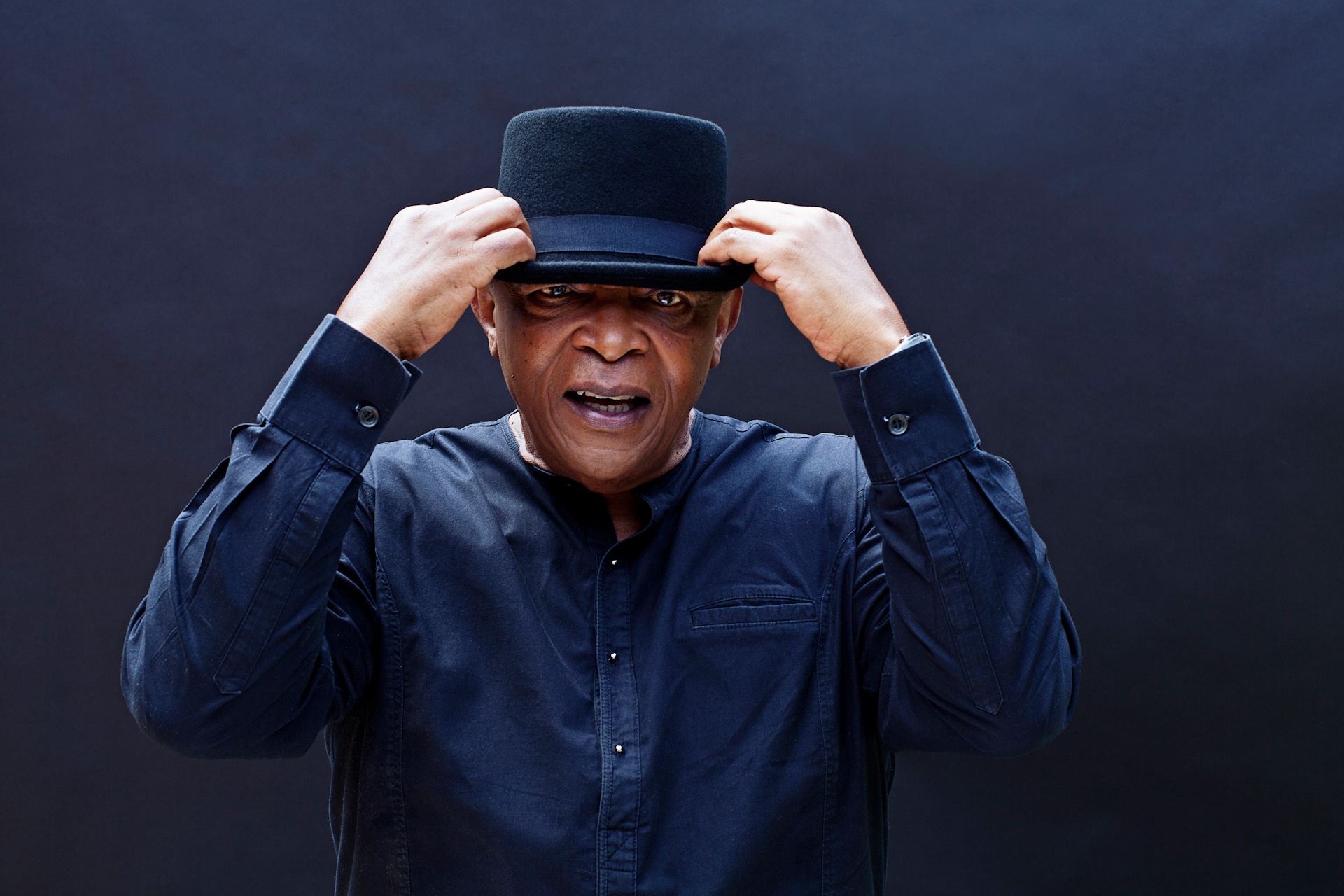
‘Never forget where you came from,’ Louis Armstrong once told Hugh Masekela.
He never has.
Hugh remembers growing up in the KwaGuqa township outside Witbank, where women ran alongside the coal trains with tin cups to collect the nuggets that fell from the cars. He remembers playing soccer with a worn tennis ball in the gravel street, occasionally losing a big toenail when he kicked a concealed rock.
But most of all he remembers the music.
He sang nonsensical children’s songs such as ‘Picky, Picky Mabelani’ while sliding down grassy hills in sleds made from old car bumpers. He listened to the miners’ heartbreaking, homesick songs about lost relatives and distant homelands at his grandmother’s shebeen. He watched warrior ensembles dance, drum, clap and chant in empty fields and vacant lots. He was mesmerised by his uncle Putu’s wind-up gramophone: ‘I wanted to move into it and live with those people who were making the music inside it’.
He was spellbound by the month-long preparations for a typical township wedding. ‘The betrothed’s young neighbours, friends and relations would conduct a nightly wedding songs choir practice from dusk until close to midnight, marching up and down the street, singing the most beautiful songs accompanied by occasional, very intricate choreographed moves that were a pure joy to witness.
‘Later on, as a teenager, I was allowed to join in the rehearsals.’
By that point, Hugh knew he wanted to be a musician. Enthralled by the Kirk Douglas film Young Man With a Horn, he asked the chaplain of his school, Father Trevor Huddleston, for a trumpet. It cost just 15 pounds but set off a chain of events straight out of a Hollywood film, culminating in the youthful Huddleston Jazz Band receiving one of Louis Armstrong’s own horns.
‘That was our window to fame,’ remembers Hugh. ‘After that, everybody looked for us, and we even appeared in the pages of Vaderland, Huisgenoot and Farmer’s Weekly,’ he grins.
By the time he was 20 he’d jumped off the pages and on to the stage – in the blockbuster Miriam Makeba-starring musical King Kong and later with Abdullah Ibrahim’s ground-breaking Jazz Epistles. The only way forward was up – or overseas.
‘It felt bad to leave South Africa because I didn’t want to,’ he admits. ‘But I was prepared to go through anything to achieve the kind of music schooling I needed. So I hustled.’
Shortly after the 1960 Sharpeville massacre, Father Huddleston helped him secure a place at London’s prestigious Guildhall School of Music, before Miriam Makeba and her mentor, singer and anti-apartheid activist Harry Belafonte, landed him a spot at New York’s Manhattan School of Music. Already a star in the US, Miriam also helped pay his tuition, bought him a new trumpet and introduced him to her friends, jazz legends such as Dizzy Gillespie, Miles Davis and Nina Simone.
‘But the greatest legacy I got from Miriam,’ Hugh remembers fondly, ‘is that she taught me the traditional healer songs her grandmother and mother sang. Miriam and her daughter were so happy when I came because they could teach them to me and that gave me a grounding to be focused on home and its heritage.
‘Also that’s how I got known – I didn’t play American music.
‘Belafonte advised me to try to draw from the people I came from,’ Hugh recalls. ‘And also to give back. He said: “You’re singing and playing their music, you owe them forever”.’
The advice rang true, just like Louis Armstrong’s had, and on graduating he planned to return to South Africa to impart his newly gained knowledge. But Belafonte had another suggestion: stay put.
‘He told me: “Hugh, nobody knows you. You’re going to go down there and, with a mouth like yours, you’re going to be thrown in jail. Why don’t you stay here and try to make a name for yourself? If you make it you will have access to the media and you’ll have visibility and you can talk about your country.”’
And that’s exactly what Hugh did, passionately speaking out about the apartheid regime’s injustices as his own star ascended, eventually hitting the number-one spot on the US charts with 1968’s ‘Grazing in the Grass’. But even the fame, success and side orders of fast cars, beautiful women and mind-altering recreational substances couldn’t mask his loneliness.
‘There is nothing as lonely as exile,’ he says. ‘The first time you hear music from your home, it goes to your eyes right away.’
So too he was brought to tears after dreaming in English for the first time. But ‘perhaps the biggest cry we all heard’ was at the burial of journalist Nat Nakasa. ‘He was the first South African to die in exile, and we were not crying so much for him as from the fear that we, who were so passionate about home, would never see it again.’
He’d reluctantly accepted that fear had become a reality after 20 years away. ‘I’d been unable to bury my mother, that is as far away from home as you could get.’
But South Africa and its people were always in his thoughts. ‘We just left physically, spiritually we were here’. And after a decade in the US, he’d already started the long journey back home, moving to Guinea, Liberia and Ghana, playing with Nigerian musician Fela Kuti, and catching the Muhammad Ali versus George Foreman fight in Zaire along the way. By the early 1980s he had settled in Botswana to establish a music school and recording studio, where he collaborated with musicians from home, creating a hot spot of cultural activity.
His work hadn’t gone unnoticed.
‘Nelson Mandela sent me a birthday card on 4 April 1985 congratulating me and encouraging me to continue what I was doing. It really blew me away,’ he recalls.
Moved by the letter, Hugh sat down at his piano and spontaneously began singing what would become a globally ubiquitous anti-apartheid anthem: ‘Bring back Nelson Mandela / Bring him back home to Soweto / I want to see him
walking down the streets of South Africa.’
‘I didn’t write that song,’ Hugh says with typical humility. ‘Mandela sent it to me.’
Shortly after Madiba finally returned home to walk down the streets of South Africa, so did Hugh. But he discovered that the music of his childhood – the songs that echoed around the townships – wasn’t there any more; another victim of apartheid.
‘Our heritage was almost banned,’ he explains. ‘And, of course, if you’re impoverished, you can’t really practise your heritage.’
So now his biggest passion is what he calls ‘heritage restoration’, reviving the tradition, culture and pride that’s now being challenged, threatened even, by the continued allure of the Western world.
‘My biggest fear,’ he offers simply, ‘is that our grandchildren are going to say: “It’s sad that we were Africans long ago”.’
But he’s up for the challenge, fuelled by an energy and enthusiasm he’s had since kicking his drug and alcohol addiction and setting up an organisation to help other addicts more than a decade ago. So he’s established a performing arts restoration society, revisited tunes from his youth on recent albums and has cofounded the theatre company behind Songs of Migration, a musical that harks back to the songs he heard in his grandmother’s shebeen. Throw in a still-hectic touring schedule and it’s clear that music remains central to his life.
‘Music is a language that everyone understands all over the world. Without music, life would be very scary, so I don’t see what I could be other than a musician. Do you have any suggestions?’ he chuckles.
He doesn’t really need any though – at the age of 72, Hugh Masekela is a musician, human rights activist, addiction interventionist, Aids campaigner, theatre producer, soundtrack composer, novelist, storyteller, father, avid gardener and t’ai chi exponent.
Just don’t call him a role model.
‘I think anybody who wakes up and looks in the mirror and says: “Wow, I’m a role model” is full of shit,’ he says with the same no-nonsense honesty that characterises his best work. ‘I just try to work as hard and as much as I can.
‘I don’t look in the mirror – I’m not interested in myself any more. I think I should be more interested in what I can give back.’
- This article originally appeared in Signature, the official magazine of Diners Club South Africa.


