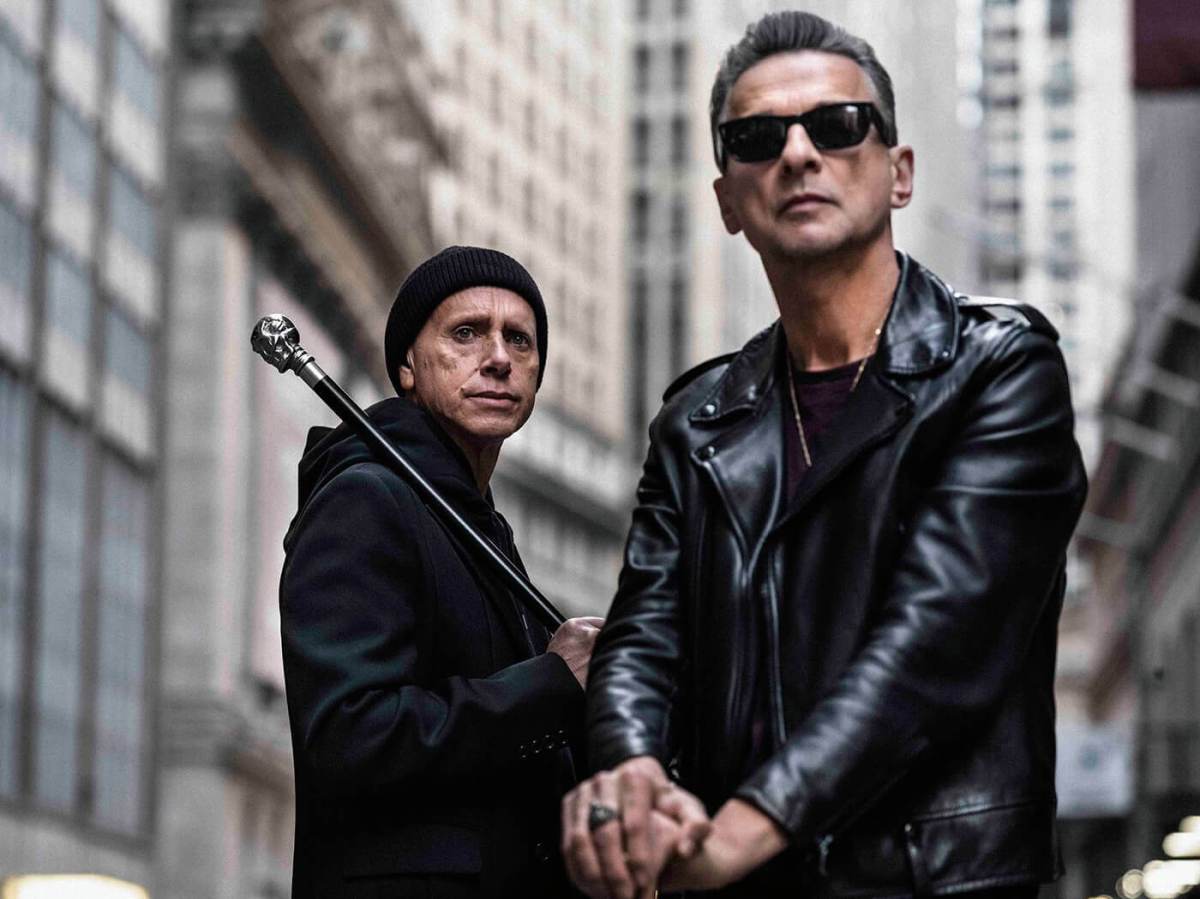
Memento Mori is an anomaly. Album 15 of a 40-year career is supposed to be business as usual. It’s supposed to be slightly worse than the one that came before, which was slightly worse than the one that came before. It’s supposed to have a lead single that sort of sounds like a big hit from the back catalogue, plus a bunch of other songs that sound tired at best. It’s not supposed to be a time for firsts. And it’s really not supposed to be this good.
But Depeche Mode are an anomaly too. Still trading on their outsider status, they’re the shiny synthpoppers from Basildon who lost their main songwriter after one album, but, within a decade, were selling out stadiums in the United States with dark, twisted songs about death, sex, and religion. Now, more than 30 years after the commercial peak of Violator, the “biggest underground band in the world” have just begun an ever-expanding 80-date global tour. Clearly, Memento Mori didn’t have to be a time for firsts. Except it did.
The impact of the Covid-19 pandemic didn’t just work its way into main songwriter Martin Gore’s lyrics (they’re even more focused on loss and isolation than ever before); lockdown opened him up to trying something new: writing with someone outside the band for the first time. And here’s the truth: those four collaborations with Richard Butler of The Psychedelic Furs are some of Depeche Mode’s best songs in years. The imperial Ghosts Again? That’s just one.
Memento Mori’s other first was even more dramatic and unexpected. The sudden death of founding member (and Gore’s best friend) Andy Fletcher just six weeks before recording started, didn’t just change the mood of the sessions. It changed the whole dynamic of the group. “Fletch” didn’t write or sing anything. But he was the tastemaker, the one who reigned in the more esoteric tendencies of Gore and frontman Dave Gahan. He was the cheerleader (“Depeche Mode’s biggest fan”), the one who kept the mood up during long days in the studio. He was the diplomat, the one who acted as a filter (and sometimes peacemaker) between the two creatives.
Without him, Gore and Gahan were forced to confront their differences and collaborate more intimately and honestly than ever before.
The result is a unified, focused collection of incredibly strong songs. As Gore himself put it, the aim was to “declutter” things. And with the help of just two co-conspirators — returning producer/multi-instrumentalist James Ford and programmer/mixer/engineer Marta Salogni — they’ve done just that. Twelve tracks, 50 minutes, one immersive experience cleverly introduced by the dystopian soundscape that is My Cosmos Is Mine. Over hypnotic industrial rhythms, icy synths, and Gore’s ghostly backing vocals, Gahan intones “No rain, no clouds/ No pain, no shrouds/ No final breaths/ No senseless deaths”.
Wagging Tongue, a rare Gahan-Gore co-write, is more conventional, balancing a bright keyboard line with a sinister bassline and refrain of “Watch another angel die” before the optimistically bleak Ghosts Again doubles down on familiar, ever-recurring themes of heaven, faith, and mortality. Memento Mori means “remember you must die”, after all. And, although these songs were written while Fletcher was still alive, his absence now makes them feel more poignant, more painful, more real.
Don’t Say You Love Me shifts focus to another Gore staple: desire and obsession. A twisted love song in the vein of Stripped, musically it’s all twangy guitars, lush strings, and a baritone croon. It’s very Scott Walker, as Gahan points out, and wouldn’t sound out of place on the frontman’s Soulsavers side project, despite being a Gore-Butler co-write.
Continuing the hot streak that began with The Psychedelic Furs’ last album, Butler’s also part responsible for My Favourite Stranger. Pure claustrophobia, it pairs menacing, almost whispered, lyrics (“My favourite stranger/ Stands where I stand/ Leaves crime in my wake/ And blood on my hands”) with throbbing bass synths and guitars that saw and scream. Soul With Me, this album’s one-sung-by-Gore, is typically a far more beautiful, less threatening proposition — even if his tender vocal and rich orchestration are swaddling lines like “I’m going where the angels fly”.
Caroline’s Monkey, the last of the Butler collaborations, is a nimble creature that brings in big glitchy beats and synth squelches to kick off side two of what’s clearly a thoughtfully sequenced LP. The journey continues with Before We Drown, the collection’s first Gahan song. Clearly a writer still on the ascent, he’s able to take his Spirit contribution Cover Me even further, through more confidence, more conviction, more melody, more precision.
Its lush ambience is immediately, and effectively, undercut by the pulsing, paranoid People Are Good (spoiler: they’re not) before unapologetically sincere love song Always You offers not just respite but hope. “There’s always you/ The light that leads me from the darkness,” Gahan sings, but the tenderness doesn’t last long. If Always You is A Question Of Lust, the pounding Never Let Me Go is A Question Of Time — a far more urgent, carnal proposition that opens with a bold statement of intent: “I’m waiting for your love/ I know you’ll want me/ When your body’s had enough”.
Speak To Me provides the comedown. The Gahan song also acts as the record’s full circle moment, wrapping up the album just as it began. Atmospheric, cinematic, like the theme that might play over the end credits of a profound sci-fi film like Interstellar, it begins slowly, quietly, considered, building up to the album’s final line. “I’m listening, I’m here now, I’m found,” Gahan offers, bringing everything on Memento Mori into sharp, but brief, focus. Almost as soon as he stops singing, though, the music becomes more ominous, more oppressive, more tumultuous. Make the most of life, the implication seems, because remember we must all die.
- This article originally appeared on Louder Than War.
 Nils van der Linden