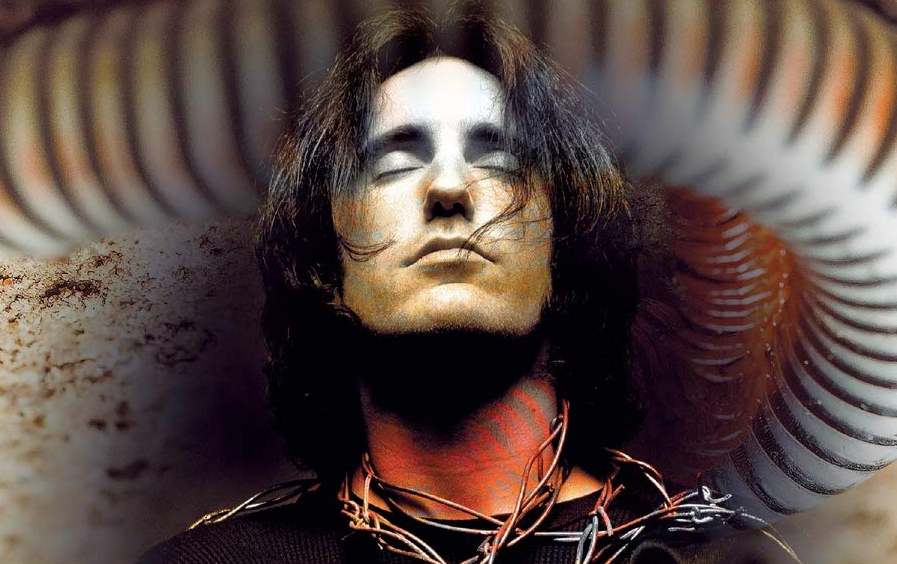
Trent Reznor is now a married, 57-year-old father of five who won his second Oscar for soundtracking a Pixar film. But he’s always been more than your average rock musician. And, as evidenced by Nine Inch Nails’ 2018 offering Bad Witch and the group’s still incendiary live shows, he’s also retained the conflicting brutality, insecurity, aggression, and pained beauty of his finest work: 1994’s The Downward Spiral.
So much more than the collection that gave alternative dancefloors Closer and the world (via Johnny Cash) Hurt, it’s a complex, semi-autobiographical exploration of a man’s descent “down the spiral” towards nothingness, shedding everything around him in the process. And for Reznor, its sound (industrial rhythms, sawing guitars, ambient piano) and subject matter (trauma, religion, depression, addiction, sex, and social unease) created the template for a hugely successful career now spanning more than 30 years.
In his introduction to Into The Never: Nine Inch Nails And The Creation Of The Downward Spiral, Adam Steiner writes: “Reznor spoke about his intent to create a densely layered album that revealed itself to the listener over time.”
The same can be said of Steiner’s book, a meticulously researched sociopolitical, cultural, and musical analysis that’s every bit as intricate and impeccably crafted as the masterpiece it examines. There’s so much in here — from fascinating musical factoids like Closer’s sampling of Iggy Pop’s Nightclubbing to philosophical investigations of influences like Friedrich Nietzsche’s Thus Spoke Zarathustra — that it absolutely rewards repeated reading.
Of course, Into the never covers the album’s creation at Le Pig, the residential recording studio Reznor somewhat notoriously set up in the house where Charles Manson’s followers had murdered the actress Sharon Tate. Using archival content and quotes from sources like Kerrang and Guitar World, as well as exclusive interviews with collaborators including guitarist Adrian Belew and mixer Sean Beavan, Steiner details the minutiae of the recording process. The origin of samples, the use of a recurring motif of a few descending notes to tie together songs, and Belew’s “very profound, very powerful” experience of working with Reznor’s experimental approach are just some of the revelations.
Obviously, it breaks down the individual songs. With a chapter devoted to each of the 14 tracks, the author dissects the individual themes — both musical and lyrical — with the precision of a forensic pathologist. The analysis of Reptile, for example, incorporates references to Manic Street Preachers’ She Is Suffering; the use of metallic sounds, sci-fi effects, and even a slowed down sample of a camera shutter to “suggest transformation and dehumanisation”; the Garden of Eden; “bodily and emotional ruin”; the theory of evolution; rejection and desire; The Texas Chainsaw Massacre; “obsession spilling over into addiction”; and even Courtney Love.
Astutely, it takes an overarching look at the album “constructed to be listened to as a self-contained whole”, with entire chapters dedicated to pulling together the various strands running through Reznor’s work of art. One looks at his use of “power, ambience, and silence to control narrative tension” as well as the instruments and techniques that achieve this, another at how the album and its creator intertwined with David Bowie’s body of work. There’s a deep dive into the influence of film (especially horror) and Reznor’s fascination with visual media, which relates directly to the controversial Closer video and a revealing backstory on the cover art. There are even looks at the role of persona, mental health, and the impact of technology on the final product.
And, most importantly, it carefully contextualises The Downward Spiral, in terms of Reznor’s own life experiences, personal obsessions, and entire career; how it relates to the history of a country built on violence and the NRA; the album’s cultural and societal legacy; and, ultimately, Steiner’s own evolving relationship with it. With typical consideration and no hint of gratuity, he covers everything from Reznor’s “piece of shit” hometown (Mercer), Fight Club, the Colombine shootings, Ian Curtis, HIV/Aids, the Manson murders, the first Gulf War, and Richey Edwards to Childish Gambino’s 2018 hit This Is America.
But even freed of this context, the album remains compelling and vital, almost three decades after its release. As Steiner himself says in the final chapter: “With every listen to The Downward Spiral’s shell-shock power of emotional and musical command, the experience feels new, like hearing it for the first time, returning to a submerged but familiar dark place in the mind that enables us to vent our suppressed rage and forces us to confront and re-engage with our sense of empathy.”
- This article originally appeared on Louder Than War.
 Nils van der Linden